Live Online | Wednesday, August 5 @ 7:00 PM ET | Limited Spots Available
For high-income parents earning roughly $200,000+ who pay meaningful taxes and have college costs on the horizon
The Tax-First College Funding Briefing with Lance Morgan
Your Tax Bill Could Be Your Greatest Source of College Funding
Most high-income families are told to save more, use a 529 plan, use retirement savings, or just pay cash when college costs come due.
But for the right family, the bigger opportunity may be hiding in a place they rarely connect to college planning:
Their annual tax bill.
On this live webinar, Lance Morgan will show you how to examine your tax bill through a college-funding lens, how a properly designed Tax Scholarship strategy may create additional resources for college, and why the right approach depends on your family, your tax profile, your goals, and professional review.


The College Funding Conversation
Usually Starts in the Wrong Place
Most families start with the obvious question:
“How much do we need to save for college?”
That question matters. But for high-income parents, it is often not the first question.
The better first question is:
“How much money is already leaving our family every year in taxes, and could a smarter strategy turn part of that into college funding?”
W-2 earners and high-income families often carry some of the heaviest tax burdens. Meanwhile, many financially sophisticated families use legitimate tax incentives, leverage, cash flow, and coordinated planning to make their money work differently.
This webinar shows you how to apply that thinking to college.
Not by relying only on small private scholarships.
Not by hoping a school suddenly gives more aid.
Not by blindly draining savings or retirement.
But by starting with one of the largest annual expenses in many high-income households: taxes.
Instead of paying tuition and watching your savings disappear, what if better planning could allow some of the money you are already paying in taxes to become part of your college funding plan?


What Is a Tax Scholarship?
A Tax Scholarship is not a traditional scholarship awarded by a school, foundation, or government program.
It is our name for a coordinated college-funding strategy that starts with the taxes a family is already paying and asks:
“Could one or more qualified strategies help reduce our tax burden and create additional resources for college?”
For some families, the answer may be yes.
For others, a particular strategy may not be suitable.
The purpose of the webinar is not to prescribe one product or promote one universal solution. It is to help you understand the framework, see what may be possible, and identify the questions that should be reviewed with qualified tax, legal, and financial professionals.
The Five-Step Tax Scholarship Framework
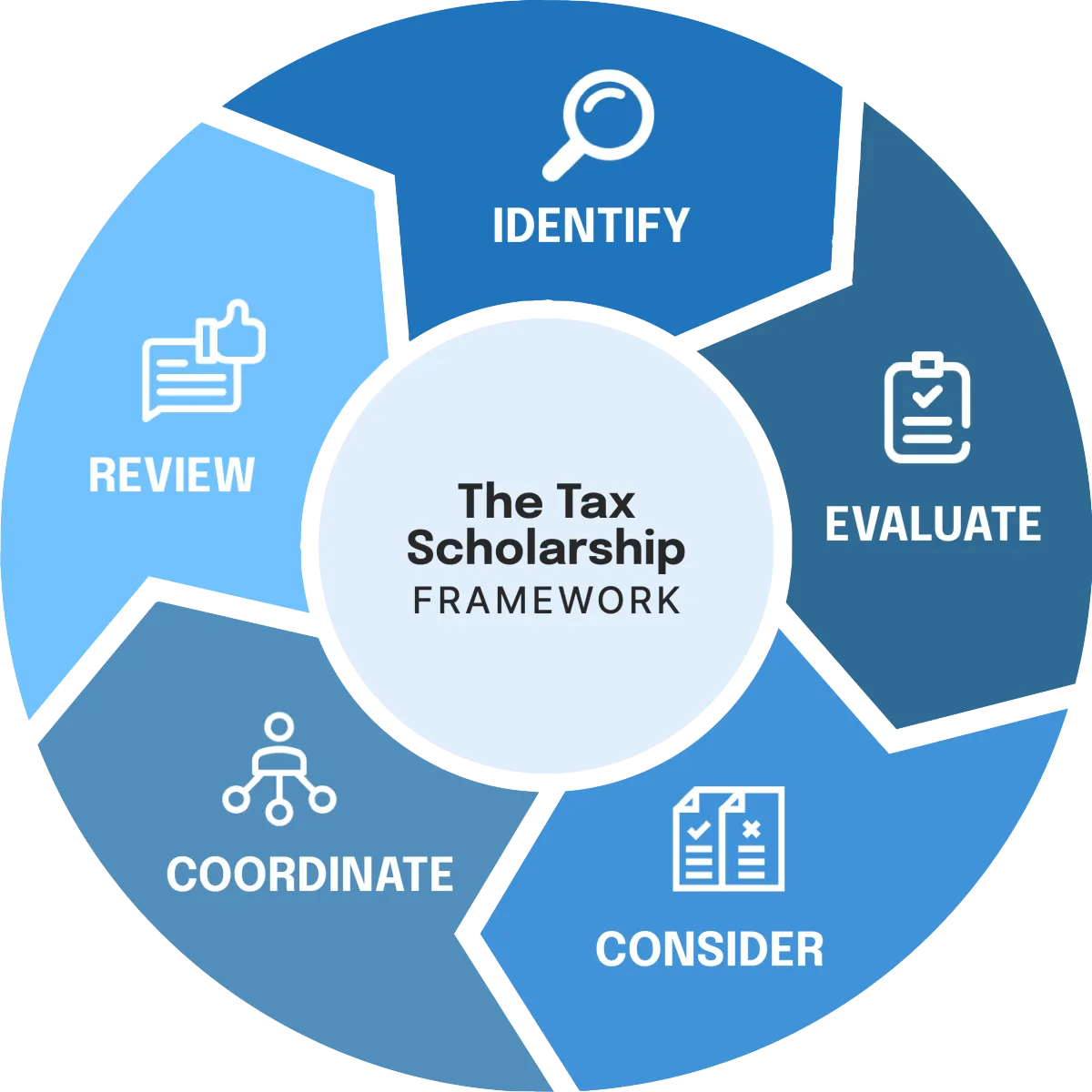
1. Identify what your family is already paying in taxes.
2. Evaluate whether qualified strategies may create legitimate tax benefits.
3. Consider whether leverage or potential cash flow could strengthen the college-funding plan.
4. Coordinate the strategy with college timing, financial aid eligibility, existing savings, and retirement goals.
5. Review suitability, risks, and implementation with the appropriate professionals.
The goal is not to find a clever deduction.
The goal is to build a legal, ethical, and economically sound strategy that may allow your money to accomplish more.
What Makes a Tax Scholarship Strategy Worth Considering?
A strong strategy should be evaluated against three important hallmarks.

A legitimate economic or social purpose
The strategy should be rooted in real economic or social activity that the government has chosen to encourage through the tax code.
It should have a genuine purpose beyond generating a deduction. It should be legal, ethical, properly documented, and reviewed by qualified professionals.

Leverage
A well-designed strategy may allow the capital you commit to create more than one form of value.
Depending on the strategy, that may include potential tax benefits, ownership or economic participation, college-funding support, or longer-term value.
Leverage can also increase risk. That is why it must be evaluated carefully.

Potential cash flow
Some strategies may produce cash flow that can help cover tuition, college-loan payments, or other education expenses.
Cash flow is never automatic. It depends on the strategy, execution, market conditions, expenses, and the family’s circumstances.
These three hallmarks are evaluation principles. They are not a promise that every strategy will provide every benefit, or that the same strategy will be appropriate for every family.

MEET YOUR HOST →
Lance Morgan
Best-Selling Author and Founder
“Parents shouldn’t have to choose between funding their child’s dream and protecting their own retirement."
Lance Morgan has spent over 20 years helping high-income families secure $100+ million in scholarships, tax savings, and retirement restoration strategies.
His work focuses on helping parents understand the complete college-funding picture, including college costs, financial aid eligibility, school-based discounts, taxes, cash flow, and retirement impact.
Lance’s goal for this webinar is not to tell every family to use the same strategy.
It is to show high-income parents how to ask better questions before writing another large check for college.
What You'll Learn
During this live webinar, Lance will explain:
Why high-income families should look at their tax bill before deciding how to pay for college
What a Tax Scholarship is and how it differs from traditional scholarships, 529 planning, and simply paying tuition with after-tax dollars
The three hallmarks of a strong strategy: legitimate purpose, leverage, and potential cash flow
Why the right approach may look very different for a $200,000-income family than it does for a family earning $400,000 or more
Why no strategy should be selected without considering risks, timing, liquidity, college costs, and professional review
How college loans may fit into the plan when potential tax benefits or cash flow are available to help support the payments
Where increased financial aid eligibility and school-based discounts may still fit into the strategy
How to use the College Cost Calculator before the webinar so you can understand your numbers more clearly

This Webinar Is Built for Families Like This
This webinar may be especially relevant if:
Your household earns roughly $200,000 to $400,000 or more
You pay a meaningful amount in federal or state taxes
You have one or more children approaching college, already accepted, or currently enrolled
You want to help pay for college without blindly draining savings or retirement
You want to understand whether legal, tax-smart planning may create additional college-funding resources
You are open to evaluating different strategies instead of being sold one predetermined product
You want strategy, structure, and a guided path instead of another do-it-yourself idea
You want to explore opportunities to increase financial aid eligibility or uncover school-based discounts
You understand that tax, legal, financial, and investment professionals may need to review any strategy before implementation
This Is Probably Not for You If...
This webinar is probably not the right fit if:
You are looking only for admissions help or essay coaching
You do not have meaningful taxable income
You want guaranteed tax savings, cash flow, or investment results
You want a one-size-fits-all strategy without professional review
You are not planning to help your child pay for school in a meaningful way
You are looking for a cheap internet course instead of a strategic planning conversation
You are unwilling to evaluate the risks, requirements, and tradeoffs of a strategy
You want a tax deduction without a legitimate economic or social purpose

Before You Write Another Big Check for College, See Whether Your Tax Bill Can Help Fund the Plan
If your family earns strong income, pays meaningful taxes, and has college costs coming due, this webinar will show you a different way to think about the problem.
You do not have to automatically default to cash, 529 plans, retirement savings, or larger college loans.
Start with the tax bill. Learn the Tax Scholarship framework. Understand the three hallmarks of a strong strategy. Then decide whether this strategy belongs in your family’s college funding plan.
🎥 Live Webinar: Wednesday, August 5 @ 7:00 PM EDT
👨🏫 Host: Lance Morgan, Best Selling Author and Founder
Copyright © 2026. Legetty Educational Services Inc. All Rights Reserved.
Privacy Policy | Terms of Service